Quality Enhancement Cell
The Office of Institutional Quality Assessment & Effectiveness (IQAE), also known as the Quality Enhancement Cell (QEC), at Women University Multan is responsible for promoting, implementing, and sustaining quality assurance mechanisms in accordance with the guidelines of the Higher Education Commission (HEC) of Pakistan.
The office ensures that academic and administrative processes meet national and international quality standards through continuous monitoring, evaluation, and improvement.
Vision
To foster a culture of continuous quality improvement that enhances teaching, learning, research, and governance at Women University Multan.
Mission
To implement transparent, systematic, and evidence-based quality assurance practices aligned with HEC standards to ensure excellence in academic programmes and institutional performance.
Objective
The objective of the establishment of the Offices of Research, Innovation and Commercialization (ORIC) is to develop, expand, enhance and manage the university’s research programs and to link research activities directly to the educational, social and economic priorities of the university and its broader community. The ORIC is also responsible for assuring that the quality of research reflects the highest international standards and advances the stature of the university among the world’s best research institutions. In pursuit of this mission the ORIC has the responsibility of guaranteeing that all research programs and policies reflect the core values of academic freedom, professional integrity and ethical conduct and full compliance with all policies, legal requirements and operational standards of the university.
In short, the ORIC seeks to enhance the environment for all research and scholarship by:
- Supporting the university’s strategic research directions and policies.
- Increasing and diversifying external research funding.
- Improving recruitment and retention of top faculty.
- Improving integration of research and education at all levels of the university.
- Improving translation of research into the public benefit.
- Strengthening university-industry relationships.
- Promoting entrepreneurship, technology-transfer and commercialization activities that energize and support the local and national economy.
Functions & Terms of Reference (HEC-Aligned)
The IQAE/QEC performs the following core functions:
- Implementation of HEC Quality Assurance Framework and Policies
- Coordination of Programme Self-Assessment (SAR/PREE)
- Facilitation of Institutional Performance Evaluation Review (IPER/RIPE)
- Monitoring of teaching, learning, and assessment processes
- Coordination with accreditation councils and external review bodies (Add following Links)
- Pakistan Bar Council (PBC)
- Pakistan Council for Architects and Town Planners (PCATP)
- Pakistan Medical & Dental Council (PMDC)
- Pakistan Engineering Council (PEC)
- Pakistan Nursing Council (PNC)
- Pakistan Pharmacy Council (PCP)
- Pakistan Veterinary Medical Council (PVMC)
- National Council for Homoeopathy (NCH)
- National Council for Tibb (NCT)
- Allied Health Professionals
Accreditation Councils Established by HEC:
- National Accreditation Council for Teachers Education (NACTE)
- National Agricultural Education Accreditation Council (NAEAC)
- National Computing Education Accreditation Council (NCEAC)
- National Business Education Accreditation Council (NBEAC)
- National Technology Council (NTC)
- Management of student, alumni, employer, and faculty feedback systems
- Monitoring compliance with HEC policies, NQF, and accreditation requirements
- Capacity building of faculty and staff related to quality assurance
- Preparation of annual quality assurance reports
- Promotion of Continuous Quality Improvement (CQI)

Dr. Farah Deeba
Director QEC
Welcome to the Office of QEC at Women University Multan.
Quality assurance is not a one-time activity but a continuous process that requires institutional ownership, transparency, and stakeholder engagement. Our office is committed to strengthening internal quality assurance systems, aligning academic programmes with national standards, and ensuring evidence-based improvement across the university.
We look forward to working collaboratively with faculty, students, administration, and external stakeholders to enhance academic excellence and institutional effectiveness.
QEC Work
Programme Self-Assessment (SAR / PREE)
Institutional Review (RIPE / IPER)
Accreditation & NOC Status
Feedback, Complaints & Grievance Redressal
Reports & Publications
Downloads
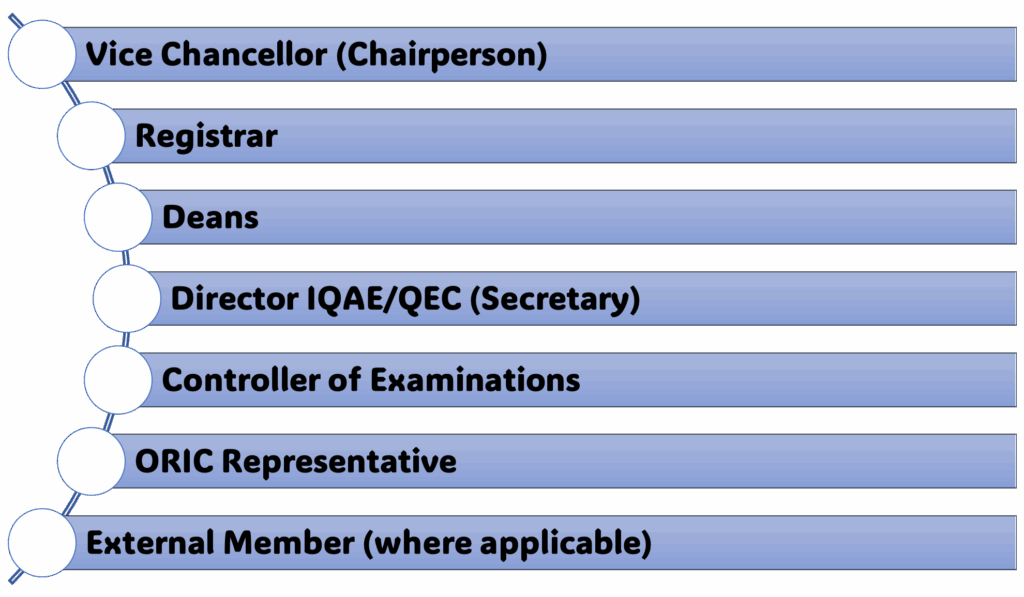
Governance – Institutional Quality Circle (IQC)
Compositions
Functions
· Review institutional performance and quality indicators.
· Approve quality policies and action plans.
· Monitor implementation of CQI initiatives.
· Review outcomes of programme and institutional reviews.
QEC Staff












WUM Research & Innovation
Brings excellence in knowledge, research and innovation that impacts society, industry and economy through fostering strong industrial networks that includes entrepreneurs, investors and professionals for mentoring, learning, research collaborations, commercialisation and employment.
WURI RANKING
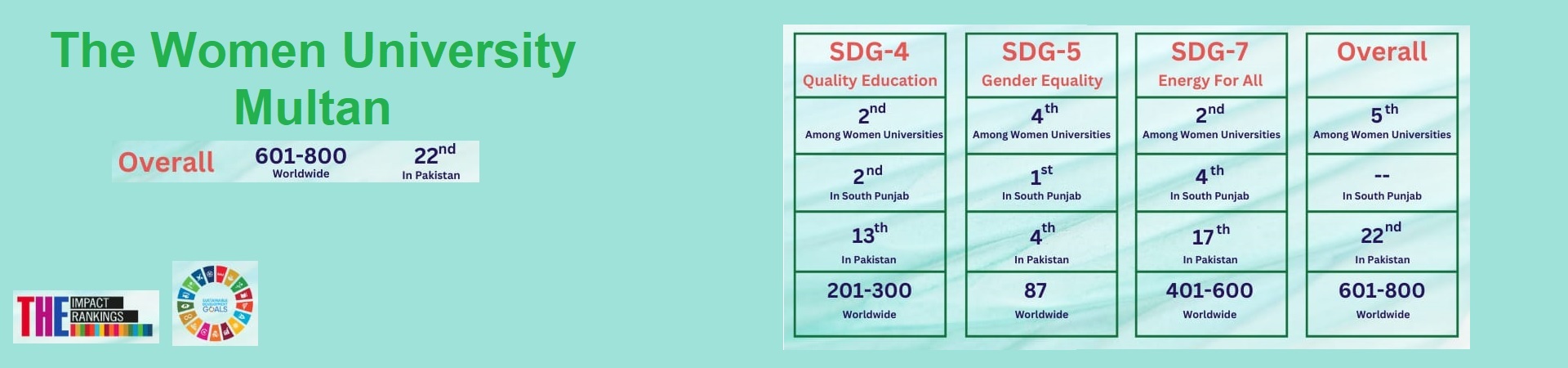
The Organizing Committee of the Second Conference of the Hanseatic League of Universities has formed a task force to prepare a new university ranking system. It is titled “World’s Universities with Real Impact (WURI)” and evaluates the university’s real contributions to our society. WUM participated in WURI ranking for the first time and ranked in 100-200 universities.
UI GREENMETRIC WORLD UNIVERSITY RANKINGS
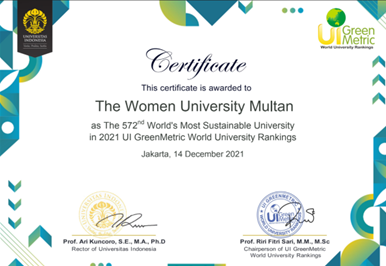
The aim of this ranking is to provide the result of online survey regarding the current condition and policies related to Green Campus and Sustainability in the Universities all over the world. The focus is to draw the attention of university leaders and stake holders to combat global climate change, energy and water conservation, waste recycling, and green transportation. Such activities require change of behavior and providing more attention to sustainability of the environment, as well as economic and social problem related to the sustainability. The Women university Multan applied the green metric rankings for the first time and WUM has been declared as First green University among all the Women Universities around the World and 572nd Worlds Most Sustainable University in 2021.